.png)


Subscribe to newsletter
Subscribe to receive the latest blog posts to your inbox every week.

Let's begin with the simple idea that human connection mainly happens through voice. It's how we show what we mean, how we feel, how urgent something is, and how we talk to each other. These little details are hard to put into emails, messages, or online forms.
81% of service professionals say they prefer to use the phone when solving more complicated problems. While 89% of customers say they prefer brands that offer voice AI support, this shows how important speaking and voice communication are, and I'm genuinely excited about how Voice AI is changing the way we communicate and solve problems.
Whether you're managing customer support, streamlining recruitment, or helping your sales team work more efficiently, Voice AI agents are like a team that can grow to meet your needs, in fact, you might not even realize how helpful they can be, and where it’s headed in 2025.
In this article, I’ll walk you through how Voice AI works under the hood, the key technologies powering it, why it matters today, and what to expect in the coming year.
A Voice AI Agent is a smart, automated system that uses voice to make and answer calls instantly. Unlike simple phone menus or pre-recorded messages, these agents can understand what people say, respond in ways that make sense, and have conversations that can go back and forth.
It is like a “digital call center agent” that's always available, embedded with a capability to handle relatively more questions and always follows the set business logic.
Imagine a healthcare provider using a voice assistant to streamline routine tasks, such as:
This allows staff to:
As per stats, the AI in voice assistants market will grow to $31.9 billion by 2033. And 91% of voice assistant users interact through smartphones. These trends highlight the growing significance and widespread adoption of voice-assisted technologies already in the market.
So how does a Voice AI agent actually talk, listen, and respond like a human? Of course, it is not magic, but a precise orchestration of cutting-edge technologies working in real time.
Each voice interaction you hear is the result of milliseconds of processing across speech, language, and telephony systems, some of which integrated into our Voice AI platform are as follows:
At the heart of it all is a language model like OpenAI’s GPT-4o. This model interprets transcripts, applies business logic, and generates context-aware replies.
You can think of the LLM as the agent’s brain, it silently handles reasoning, understands language nuances, and shapes how the AI speaks and responds.
This is the agent’s ear. STT converts incoming audio (what the user says) into accurate, real-time text using providers like Deepgram.
This is the agent’s voice. TTS tools like ElevenLabs convert the LLM’s replies back into lifelike audio responses with tone, style, and even emotion.
This is the phone line. Platforms like Plivo or Twilio manage calls, dialing, routing, and hanging up.
All these components come together in a split second to deliver a seamless, human-like conversation.
What separates Voice AI from outdated IVRs or chatbots is its ability to replicate the rhythm of human speech or in simple words, feel of real human conversations.
It’s like chatting with a super-efficient assistant who’s always available, listens carefully, and never loses their cool.
Voice AI is more than an innovative technology, it has the potential to create measurable value across verticals. Here are some use cases in actions across verticals:
Automating loan reminders, KYC calls, and customer onboarding.
For example, a voice assistant can quickly confirm who you are and help you set up your account in just a few minutes.
Handling admissions inquiries, fee reminders, and course recommendations.
For instance, universities use AI agents to manage student onboarding during peak season.
Managing appointment confirmations, follow-up care calls, and medication reminders.
Stat: Missed appointments cost the U.S. healthcare system $150B annually, Voice AI helps cut this by up to 40%.
Finding potential buyers, setting up property visits, and sharing information about the properties.
For example, agents only get serious interest from people after a smart system has removed casual or uninterested inquiries.
Pre-screening candidates, collecting availability, and updating application status.
Example: One agency reduced screening time by 70% with automated voice interviews.
Providing 24/7 assistance, resolving common queries, and escalating complex issues.
Stat: 75% of customers expect help within 5 minutes, Voice AI meets that need instantly.
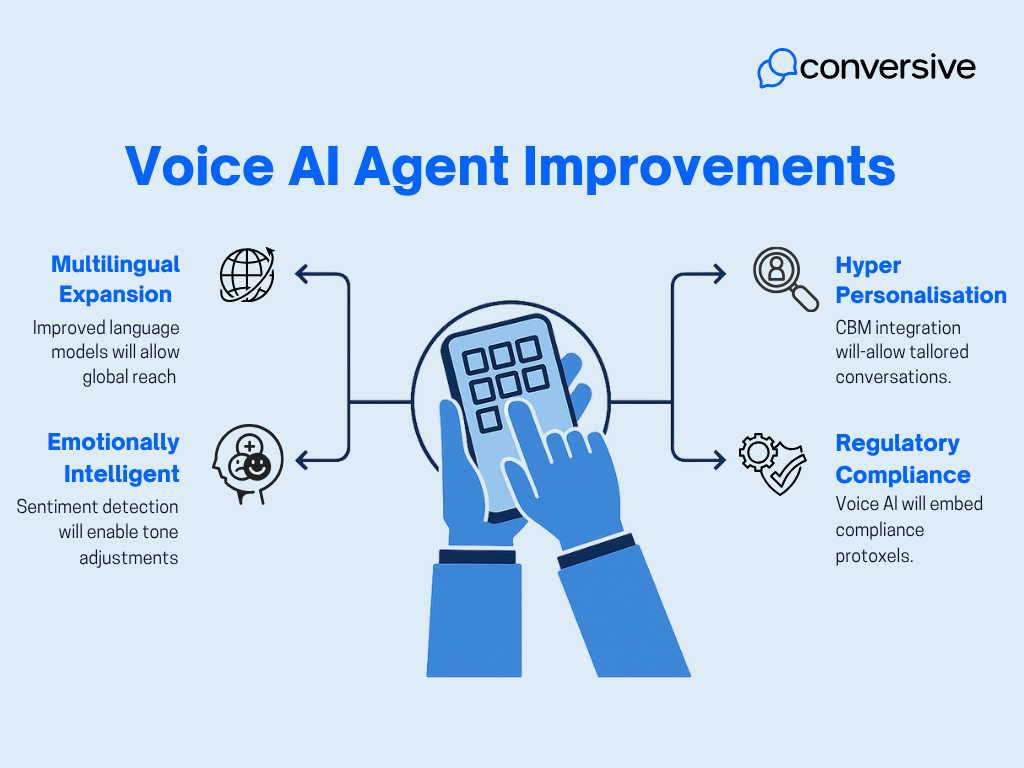
As we are halfway through 2025, Voice AI is no longer optional, it’s a strategic differentiator.
Here’s where I see it going:
The global text-to-speech (TTS) market is experiencing significant growth. In 2024, the market was valued at approximately USD 3.45 billion and is projected to grow to approximately USD 21.71 billion by 2034, reflecting a compound annual growth rate (CAGR) of 23.3% over the forecast period.
At Conversive, we’re not just building Voice AI, we’re shaping how businesses and humans communicate in real time. Whether you’re starting small or looking to scale across functions and geographies, our platform is designed to make implementation seamless.
Are you ready to give your customers a human-like experience powered by AI?
Let’s talk! Book a demo with one of our Voice AI specialists.
A Voice AI agent communicates through spoken conversations, offering real-time, natural dialogue, unlike text-based chatbots.
Yes, with Conversive you can.
Absolutely. Our platform includes encryption and follows GDPR and HIPAA best practices.
No coding is needed with Conversive’s Agent Configurator, it’s fully UI-based.
You can go live in as little as a day, depending on use case complexity.
Yes. Our platform supports webhook-based integration and API configurations.
It combines speech-to-text (STT), language models (LLM), text-to-speech (TTS), and telephony platforms.
You can design hybrid models where AI handles the initial flow and escalates to humans as needed.


Subscribe to receive the latest blog posts to your inbox every week.

We respond with 10 support messages to every support email – our customers love it.

Greg Royse
CEO, Tidy

“We were missing 58% of incoming calls. Now we answer 80% + of all incoming enquiries.”

Ajaz Elahi
Director, Sinspeed

“This product is AMAZING and is changing my business. It reaches clients 100x better than email.”

Michael Goldenberg
President, DebtCare Canada

“Conversational Messaging capabilities of SMS-Magic are among the best in the industry and offers security and reliability for SMBs to Large Enterprise Customers.”

Stan Petit
API Senior Partner Sales Manager, Vonage

SMS-Magic is a simple, powerful, SMS solution for Salesforce that has become integral to our day-to-day operations.

Martin McCauley
Director of Patient Services, BioSpine Institute

“If our loan applicants did not receive timely SMS-Magic text messages, we wouldn’t be funding loans & we would lose customers.”

David Ross
Head of IT, Upstart

“Having full-context conversation history from SMS-Magic helps us understand what has been sent to the customer across different departments and if those messages have been opened.”

Camilla Mills
Marketing Campaigns Manager, DaySmart

We average a 59% response rate from clients to text message surveys.

Craig Garber
CFO, LifeMoves

.png)