.png)

Subscribe to newsletter
Subscribe to receive the latest blog posts to your inbox every week.

Interaction through messaging - be it person-to-person or business-to-customer - is undergoing a significant shift. Ubiquitous nature of the internet and the reach of smartphones have transformed the way people communicate, making interactions faster, more dynamic and accessible to a global audience at any time. It’s like the world of interaction has evolved from morse code to live streaming.
Text message, which was once limited to 160 characters is now morphed to Rich Communication Services (RCS), the rich and interactive messaging interface that we experience today. Interestingly, the rich messaging landscape is poised to grow exponentially. In fact, growing penetration of 5G networks, global support from mobile carriers, device manufacturers and tech providers suggest that RCS will continue to accelerate. Market trends show RCS business messaging traffic to grow 50% in 2025 alone.
If we go by market analysis, according to the IOT Global Network, RCS will reach 3.9 billion users by 2025 while Infobip shows Rich Communication Services (RCS) traffic will quadruple over the next five years.
Its dynamic and multimedia environment has elevated it to a serious and major competitor to OTT platforms like WhatsApp, iMessage & Viber. After all, the combination of SMS with sophisticated modern messaging apps has made it the most disruptive agent. The platform has already proved its efficacy for vendors.
To answer the above question, let's go through the following five use cases for RCS business messaging, with real-world examples, benefits, tech highlights and challenges.
Let’s say, a clothing retailer creates an RCS campaign and sends the rich message to its niche segment. The campaign consists of a carousel of their new seasonal collection. To make things more engaging, the retailer has showcased the products in a slider format. Customers can view images, read descriptions and see & compare prices of each item in one place. Not only this, they can also add items to a cart directly in the message.
RCS functionalities provided the display of rich features like high-resolution images, carousels or sliders and embedded buttons - these will become instrumental in product selection and immediate purchase.
Device and carrier compatibility can be a hurdle. Older models, especially those running older operating systems, may not be able to access the required functionality of RCS and secondly, not all mobile network operators have adopted or fully implemented RCS services. These can lead to fragmented user experience, what can the businesses do?
Enterprises, in this case, have to employ a unified messaging API that allows them to choose the best format (SMS, MMS or RCS) for each message, depending on the recipient’s device capabilities.
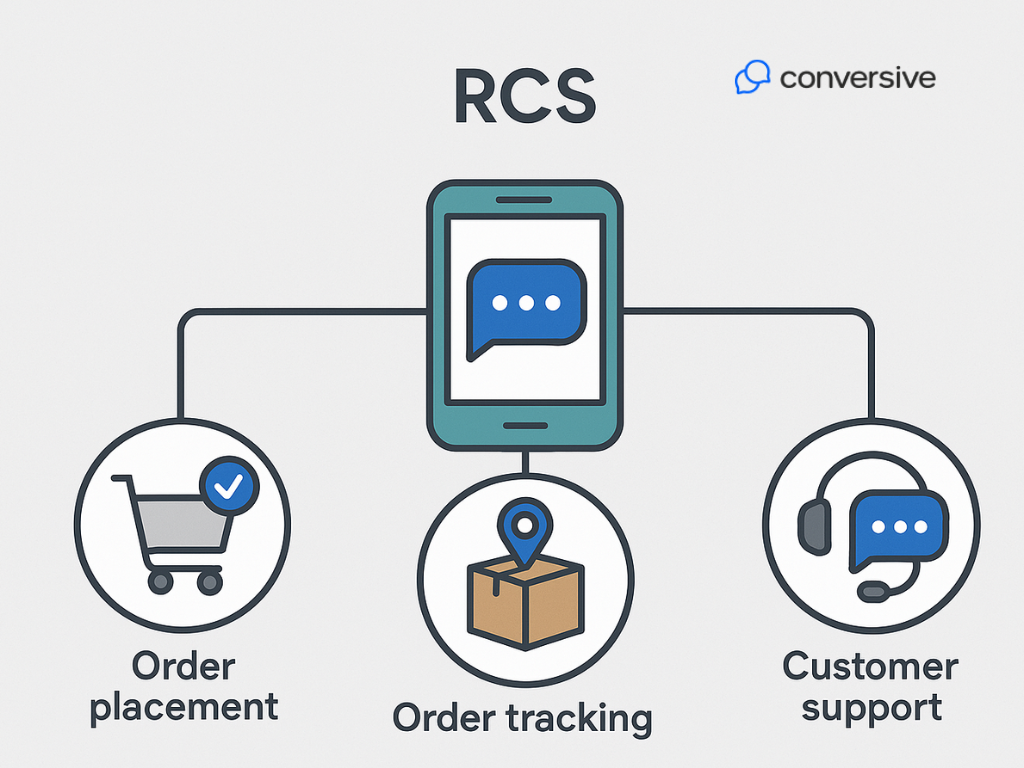
Order tracking and delivery updates are important for any e-commerce business, especially for electronic stores, since, customers as always looking forward to receive high-value items. By leveraging RCS business messaging, let’s say, Electronica can provide real-time order tracking and delivery updates, as it would help customers staying informed from order placement to final delivery. For instance, the online electronics store sends an RCS message to a customer with with following details:
RCS Business Messaging API will play along with AI-powered chatbots for automated order queries coupled with GPS tracking integration for real-time delivery updates.
Device and carrier compatibility may pose a challenge, due to which, the implementation might fallback on SMS or WA for non-RCS users.
Opt-in mechanisms for notifications are super important as the messages have to comply with GDPR, CCPA, and telecom regulations for customer data protection.
Lastly, pricing for RCS messaging varies according to carrier and region, so it’s important to take into account the location when calculating costs. so, there has to be a balance of SMS, RCS and other channels for cost-effective communication.
A patient seeking medical help found the LifeCare website. They need help with scheduling appointments, receiving reminders and getting support. LifeCare offers RCS to deliver rich and interactive customer support, here’s how the messaging journey would look like:
RCS Business Messaging API coupled with AI-powered chatbots for automated initial interactions like appointment scheduling and follow-up care.
For route & location guidance to clinics, hospitals and pharmacies, it would require map integration.
Electronic medical records for tracking appointment schedules, patient data and follow-up remind and medication management systems to send medication reminders and alerts to patients.
Not all patients may have access to RCS enabled devices, in such cases, the rich messages will fall back on SMS.
Since, there are strict HIPAA guidelines and patient privacy regulations, the messaging services need to be HIPAA compliant.
In presence of a large volume of patients there has to be an intelligent routing to manage patient flow, which can prioritize urgent cases and automatically reschedule appointments depending upon the requirement.
Glamora uses RCS business messaging to interact with customers. Its interactive features include images, carousels, buttons and quick replies. It also sends order updates, personalized promotions and offer customer support through RCS messaging. It’s prerequisite is that the customers have to opt-in to receive RCS messages from Glamora, generally through SMS opt-in or app settings. Now, let’s walk through the messaging journey:
The customer registers on Glamora and opts-in to receive the following messages via RCS messaging:
Based on the above data, the platform sends personalized RCS message to the customer about a new makeup collection or exclusive sale.
“Hi Rita! Your favorite brand Maybelline just released a new line of matte lipsticks. Tap here to check them out with 20% off today only!”
After the customer places an order, Glamora sends a rich, branded RCS order confirmation message with details like product images, estimated delivery time, and a "Track My Order" button.
If the customer has some issues with the product or requires any assistance, they can initiate a conversation via RCS chat itself. The message can include instant replies and buttons for common queries, like "Track My Order" or "Product Recommendations."
Example: “Hello! How can we assist you today? ”
After receiving their order, Glamora sends an RCS survey asking the customer to rate their experience and provide feedback, with easy-to-click buttons to collect feedback.
RCS infra can help Glamora in tracking open rates, click-through rates and customer actions. And its integration with CRM platforms can help in creating personalized offers and customer support based on the customer’s profile.
Using specific customer data such as past purchases and browsing behavior can help in creating highly targeted messages.
Not all customers may have RCS-enabled devices, and not all carriers support RCS messaging so the implementation might fallback on SMS or WA for non-RCS users.
Customers must opt-in to receive RCS messages, which can again, limit initial adoption rates.
RCS messaging requires internet connectivity, that could be either Wi-Fi or mobile data, which means in areas with limited connectivity, messages might fail to deliver or experience delays.
Coffee Beans was facing a common challenge - cart abandonment! Finally, they decided to try RCS Business Messaging. They initiated rich, interactive reminders to customers who left coffee products in their cart and encouraged them to complete their purchase. Along with the high-quality images and product carousels they also added personalized discounts, and one-tap checkout buttons, making the process more engaging and effective. Here’s how their messaging journey for abandoned cart recovery looked like:
A shopper browses Coffee Beans’ online store and adds following items to their cart but exits before completing the order:
After a few hours, Coffee Beans sends an RCS message reminding the customer about their cart.
Something like:
“Still craving the perfect brew? Your cart is waiting! Complete your order now and get free shipping. [Complete Purchase]”
Message includes:
If the customer still hasn’t checked out, Coffee Beans’ RCS chatbot offers assistance.
Includes:
If the cart remains abandoned after 24 hours, Coffee Beans sends a personalized discount offer to encourage checkout.
Example:
Includes:
After 48 hours, Coffee Beans sends a last-chance reminder, emphasizing limited stock availability.
Example:
Includes:
Rich visuals: RCS offers product images, buttons and quick replies, these makes reminders visually appealing and action-driven.
Seamless shopping: Brands (like Coffee Beans) can use browsing history, offer dynamic discounts, and provide instant support via RCS chat, which means customers can instantly buy from the RCS message without needing to open a separate app or webpage.
Sales recovery: By proactively reminding and incentivizing customers, brands can recover a significant percentage of lost sales.
RCS has to be integrated with AI chatbots to assist customers and automate cart recovery reminders.
Brands can refine RCS campaigns by tracking open rates, clicks and conversions.
The checkout process becomes seamless, with one-click purchase, a feature that is offered by RCS.
RCS also works with email, push notifications, and text messages to provide several ways to stay in touch for recovery.
Not all customers have RCS compatible devices, hence, the rich messages may fall back on SMS and email reminders.
Most importantly, users have to opt-in for RCS business messaging, otherwise, the message will not be processed.
Too many reminders can annoy customers, hence, an AI timing optimization is required for sending messaging strategically.
RCS Business Messaging is a powerful tool to stay ahead in today’s competitive messaging landscape. By integrating interactive product catalogs, real-time order tracking, personalized recommendations, AI support and automate cart recovery reminders businesses can transform their messaging into an engaging and customer-centric experience.
From seamless order support to personalized offers, RCS messaging covers almost everything, ensuring users have all they need in one place. This makes it a game changer for businesses looking to stand out in the digital marketplace.
so, are you ready to elevate your customer experience and optimize your sales strategy? Learn more about integrating Conversive’s RCS platform into your tech stack and unlock the full potential of your business communications, today!


Subscribe to receive the latest blog posts to your inbox every week.

We respond with 10 support messages to every support email – our customers love it.

Greg Royse
CEO, Tidy

“We were missing 58% of incoming calls. Now we answer 80% + of all incoming enquiries.”

Ajaz Elahi
Director, Sinspeed

“This product is AMAZING and is changing my business. It reaches clients 100x better than email.”

Michael Goldenberg
President, DebtCare Canada

“Conversational Messaging capabilities of SMS-Magic are among the best in the industry and offers security and reliability for SMBs to Large Enterprise Customers.”

Stan Petit
API Senior Partner Sales Manager, Vonage

SMS-Magic is a simple, powerful, SMS solution for Salesforce that has become integral to our day-to-day operations.

Martin McCauley
Director of Patient Services, BioSpine Institute

“If our loan applicants did not receive timely SMS-Magic text messages, we wouldn’t be funding loans & we would lose customers.”

David Ross
Head of IT, Upstart

“Having full-context conversation history from SMS-Magic helps us understand what has been sent to the customer across different departments and if those messages have been opened.”

Camilla Mills
Marketing Campaigns Manager, DaySmart

We average a 59% response rate from clients to text message surveys.

Craig Garber
CFO, LifeMoves

.png)