.png)

Subscribe to newsletter
Subscribe to receive the latest blog posts to your inbox every week.

74% of consumers expect businesses to be transparent when AI is used during service interactions. The message is clear, technology alone isn’t enough. Customers want clarity, control, and confidence.
We live in a world where we use artificial intelligence (AI) more often than we realize. From Siri to Alexa, customer experience (CX) has entered a new era. AI has now become an integral part of our space. This also means, enterprises must be transparent and accountable in their use of AI, particularly in how they engage with customers.
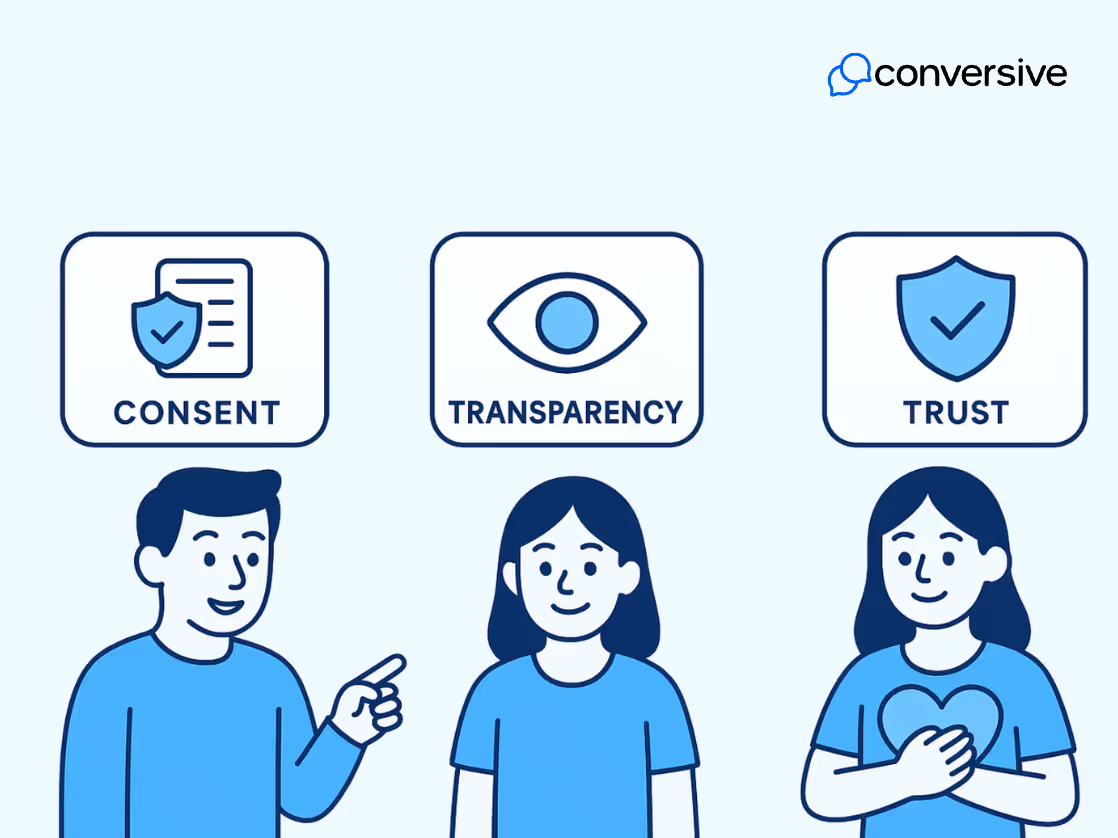
Hence, it is the right time to build ethical AI, AI that prioritizes consent, transparency, and trust. Deploying AI is still easy but the real challenge is making sure they work ethically. In this article, we are not trying to explain what AI can do in CX rather it’s about what it should do.
Let’s break it down.
AI ethics refers to a set of moral guidelines that help ensure artificial intelligence is created, used, and managed in a responsible and fair way. In a process, AI not only enhances customer experiences but it should also take care of their privacy, autonomy, and dignity.
With moral guidelines and technology being balanced in the right order, it will lead to systems that don’t just optimize metrics but also build relationships.
Every touchpoint of interaction with AI, leaves behind a record of data, an information of some sort. And when these systems are used without clear information, they can make people lose trust more quickly than any bad experience with a person might.
Imagine talking to a health chatbot to ask a personal question about a symptom you're experiencing. The chatbot responds to you, but it doesn't tell you where your information is saved, who might see it, or why it asked for your ZIP code. Later, you notice ads showing up that are about that same problem you experienced. No one warned you this would happen. Even if the tips were helpful, your trust in the app, and maybe all health technology, starts to fade.
Compare this to a human doctor, even if they were busy or forgot to return your call, you'd probably still trust them next time. With AI, because it's less clear how it makes decisions, it can feel colder and harder to forgive when things don’t go smoothly.
63% of customers are more open to sharing their data for a product or service they say they truly valued with AI. But “valued” doesn’t just mean faster, it means fair, safe, and transparent.
Therefore, using AI to improve customer experience without considering ethics is like giving a stranger access to your private diary, hoping they'll only read the parts that help them assist you. That's not how trust is built.
The main building blocks of ethical AI are consent, transparency and trust. These principles help guide the creation and use of AI in a way that respects people's privacy, builds trust, and makes sure AI systems are fair, open, and answerable. Let’s take these one by one:
Informed consent is more than just a simple message like a cookie notice. It means giving people real choice and control over how their personal information is gathered and used.
65% of users would stop buying from companies that don’t protect their data transparently. The same study shows that 70% of people are concerned about their data being used in automated decision-making.
Customers need to know when AI is being used, what it is doing, and the reasons behind its choices, so,
Almost all company leaders, about 90%, believe that customers stop trusting brands when they aren’t honest and open. The role of AI should be as a co-pilot, which fundamentally is, transparent, supportive, and accountable. Its aim is to assist users in making better decisions, and not making decisions for them in the dark.
Just like a trusted co-pilot in the cockpit, AI should offer guidance and insight while keeping the human in command, with full visibility into how and why each course is charted.
Trust isn’t built in a single moment, rather it’s earned gradually, through consistent actions that demonstrate fairness, transparency, and respect for users. Every ethical choice like how data is collected, how algorithms are trained, how recommendations are explained, together adds another layer of trust between users and the AI system.
But bias, discrimination, and data misuse are trust-killers because they do the opposite. Therefore following pointers must be kept in line:
75% of organizations believe that not being clear about how they use AI might cause customers to stop doing business with them. Sharing information about how decisions are made, like explaining why a chatbot suggests a particular product, helps customers feel more confident and trust the company.
You can use AI chatbots and recommendation systems to make sure people are treated fairly throughout their entire experience with a product or service. Here’s a quick overview of common AI use cases and how we keep them ethical.
The goal is never to manipulate, but to assist and enhance.
These foundational principles act like safety guidelines for creating, using, and managing AI. Following these rules helps avoid accidental problems and builds trust with people everywhere.
These aren’t just buzzwords, they’re our operating principles.
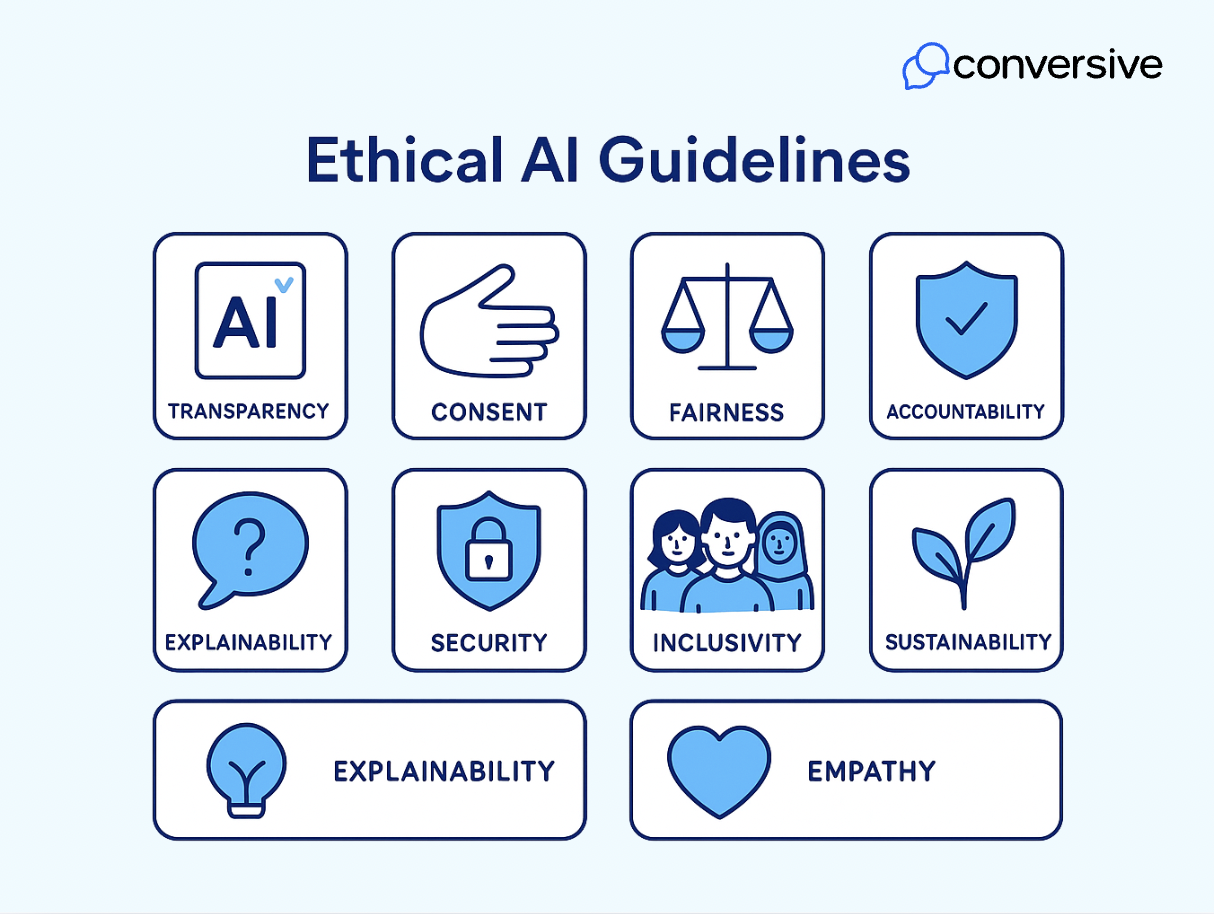
If you're using AI in your business, especially in customer experience, there's a big question that’s no longer optional, which is, Are you using AI responsibly?
As a brand, you need to take one thing seriously, AI is no longer just a tech tool, it’s a decision-maker, a brand voice, and a trust-bearer. And with great power comes, well, legal obligations, ethical expectations, and a lot more scrutiny.
So let’s make it simple. There are three major frameworks you need to know if you're working with AI today:
Here’s how they work together, and why they matter for your team.
Think of the OECD AI Principles like the moral compass for AI. They don’t tell you what speed to drive at (that’s the EU’s job), but they do tell you which direction is right.
First introduced in 2019 and refreshed in 2024, these principles are recognized by nearly 50 governments as the foundation for trustworthy and human-centered AI.
Here’s the simple version:
These principles have shaped over 1,000 AI policies worldwide. If you're building or using AI, even in something as routine as customer service automation, this is your ethical anchor.
Now, if the OECD Principles are your GPS, the EU AI Act is the actual road law.
Adopted in 2024, it’s the world’s first comprehensive legal framework for AI, and yes, it’s enforceable. That means fines, audits, and real-world consequences for getting it wrong.
So, how does it work?
The EU AI Act sorts AI systems into following four risk categories:
1) Unacceptable Risk: These are the things in AI that are considered harmful, like systems that judge people’s social status or manipulative behavioral systems.
2) High Risk: This is where most professional AI tools are stored. If your AI affects things like hiring, credit decisions, identity checks, or public safety, this is the area it belongs to. You’ll need to show that you’ve thought about the risks, kept records of how the system works, made sure humans are involved, and have plans to handle any problems that might come up.
3) Limited Risk: These systems mostly require transparency. If your chatbot is AI-powered, for example, you’ll need to tell the user.
4) Minimal Risk: This is not that alarming, AI that suggests playlists or helps change the way your emails sound. There's no complicated rules, but it's still important to watch out for any unintended mistakes or problems.
The ban was initiated in February 2025, and stricter rules will be put into place gradually through 2027. Fines for breaking the rules can be as high as €35 million or 7% of the company's total worldwide income.
Bottom line: If you’re using AI in CX, sales, HR, or product features, you need to know where your system fits. It’s no longer a choice, it’s law.
Finally, once you know what's expected and what's legal, you’ll need a how-to guide to do it right.
That’s where ISO/IEC 23894:2023 comes in. It’s like a recipe for safe AI, built by experts, recognized globally, and increasingly expected by regulators and partners.
Here’s what it helps you do:
By following this standard, you're not just protecting your brand, you’re building systems that are smarter, safer, and more sustainable.
If you’re building AI for customer experience, this isn’t just about checking legal boxes. It’s about building trust.
Every time your AI suggests a product, answers a support query, or flags a risky transaction, it’s shaping how customers perceive your brand. Do they feel heard? Respected? Safe?
Following ethical and legal frameworks isn’t just the right thing to do, it’s a competitive advantage.
So here’s your to-do list:
This is how you lead in the age of AI, not just with better algorithms, but with better choices.
Customers today don’t just expect personalization; they expect principles. And at Conversive, we help companies deploy AI solutions that are not only powerful, but principled. From consent management to ethical chatbot design, we’ll guide you every step of the way.
When we build CX strategies with consent, transparency, and trust at the core, we’re not just delivering better service, we’re building better relationships.
Schedule your free AI ethics audit today
Let’s start a conversation →
Using AI in ways that are fair, transparent, and respectful of customer rights.
It builds customer trust and reduces frustration with automated systems.
Bias checks, informed consent, explainable decisions, and human fallback options.
Yes, even simple disclosures and opt-ins make a big difference.
Loss of trust, legal penalties, reputational damage, and customer churn.


Subscribe to receive the latest blog posts to your inbox every week.

We respond with 10 support messages to every support email – our customers love it.

Greg Royse
CEO, Tidy

“We were missing 58% of incoming calls. Now we answer 80% + of all incoming enquiries.”

Ajaz Elahi
Director, Sinspeed

“This product is AMAZING and is changing my business. It reaches clients 100x better than email.”

Michael Goldenberg
President, DebtCare Canada

“Conversational Messaging capabilities of SMS-Magic are among the best in the industry and offers security and reliability for SMBs to Large Enterprise Customers.”

Stan Petit
API Senior Partner Sales Manager, Vonage

SMS-Magic is a simple, powerful, SMS solution for Salesforce that has become integral to our day-to-day operations.

Martin McCauley
Director of Patient Services, BioSpine Institute

“If our loan applicants did not receive timely SMS-Magic text messages, we wouldn’t be funding loans & we would lose customers.”

David Ross
Head of IT, Upstart

“Having full-context conversation history from SMS-Magic helps us understand what has been sent to the customer across different departments and if those messages have been opened.”

Camilla Mills
Marketing Campaigns Manager, DaySmart

We average a 59% response rate from clients to text message surveys.

Craig Garber
CFO, LifeMoves

.png)