.png)

Subscribe to newsletter
Subscribe to receive the latest blog posts to your inbox every week.

Contemporary digital landscape is all about seamlessness and hyper-personnalisation when it comes to customer expectations. However, businesses often struggle with fragmented customer journeys, which leads to dissatisfaction and churn.
Artificial Intelligence (AI), here, comes in handy as it addresses these challenges by automating and personalizing customer interactions.
This article explores how AI in the customer journey improves customer experience (CX) automation and eventually leads to customer retention.
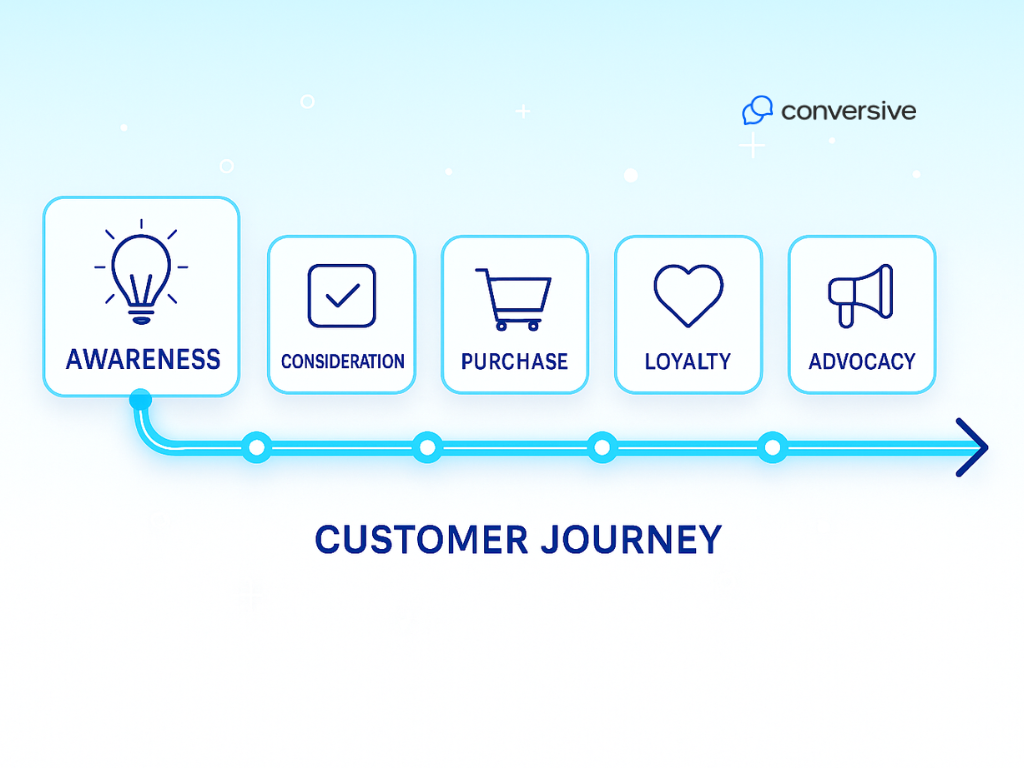
Customer journey is everything a person experiences with a brand, starting from when they first learn about it, all the way through buying something and extending into post-transaction activities including support, loyalty reinforcement, and advocacy.
Here’s what it looks like: A person sees an ad for a new sneaker brand on Instagram (awareness), visits the website to learn more (interest), reads reviews and compares it with Nike and Adidas (consideration), adds a pair to their cart (intent), buys the sneakers (purchase), loves how they feel and buys another pair a month later (loyalty), then posts about them and tells friends to try them too (advocacy).
A smooth and carefully planned experience helps make customers happy and encourages them to stay loyal. However, inconsistencies and gaps can lead to a broken experience.
Here are common breakpoints in customer experience:-
These problems show why we need smarter ways to make things easier and better for customers.
AI tools help companies understand and improve how customers interact with them. By analyzing data and handling tasks automatically, AI allows businesses to create experiences that are tailored to each person, quick, and reliable.
Using these technologies makes the customer's experience smooth and enjoyable from start to finish.
CX automation leverages AI to make customer service easier and faster, which brings many benefits:
Automating routine tasks reduces response times and operational costs. For instance, AI-powered chatbots can answer many questions at the same time, so human workers can spend more time helping with difficult problems.
AI analyzes customer data to tailor interactions, making sure it recommends products and shares content that suits each person. This helps customers feel happier and more loyal.
AI makes sure that the message stays the same across different ways people connect, giving customers a smooth and consistent experience whether they contact by email, on social media, or visit stores.
Predictive analytics help spot possible problems early on, so businesses can deal with them before they get worse and keep their customers happy.
Retaining customers is more cost-effective than acquiring new ones. AI plays a crucial role in fostering customer loyalty through:
Through the analysis of behavioral patterns, AI can identify customers who are at risk of discontinuing their engagement and consequently initiate retention strategies, including personalized incentives or targeted communication.
AI analyzes customer feedback from diverse sources and across channels to derive insights and guide enhancements in products or services.
AI tailors loyalty programs to individual preferences, enhancing their effectiveness and encouraging repeat business.
Through tailored experiences and proactive interactions, AI enhances customer lifetime value (CLV) by nurturing enduring relationships.
AI has the potential to substantially improve the customer experience by delivering personalized interactions, automating processes, and offering predictive insights, thereby ultimately fostering increased customer satisfaction and loyalty. Here’s are a few practical uses cases:
AI suggests content or guides tailored to a new customer's browsing history and interaction patterns.
Benefit: Accelerates time-to-value and reduces early-stage churn.
Whether through email, application, or messaging platform, AI guarantees that communications are contextually appropriate and aligned with the user's history.
Benefit: Increases engagement and conversions across touchpoints.
AI initiates targeted campaigns for disengaged users or lapsed customers by presenting relevant promotional offers.
Benefit: Improves reactivation rates with minimal manual effort.
AI tools examine open-ended feedback, reviews, and Net Promoter Score comments to identify instances of dissatisfaction.
Benefit: Surfaces churn signals early and informs product or CX fixes.
Through collaboration with human teams, AI enhances process efficiency, delivers actionable insights, and supports more informed decision-making. All these processes together result in increased customer satisfaction and long-term loyalty. Here’s are a few practical uses cases:
AI has the capacity to construct detailed customer profiles through the aggregation of data from multiple interaction points. This allows support agents to gain a thorough understanding of each customer's history and preferences, thereby enabling more personalized engagement and expediting resolution processes.
Through the analysis of customer behavior and feedback, AI discerns patterns and trends that guide marketing initiatives and product development. This data-driven methodology guarantees that offerings are aligned with customer preferences and expectations.
Artificial Intelligence-driven chatbots and virtual assistants manage standard inquiries, such as order tracking and frequently asked questions, delivering immediate responses and enabling human agents to focus on more complex issues.
AI watches how customers interact to find where they might be having a hard time and spots ways to make things better. This helps teams quickly try out new ideas and improve the overall experience for customers.
Successfully integrating AI into the customer journey requires a structured approach:
Find the important steps customers go through and where they might lose interest or move away.
Focus on improving important moments, like when new users sign up or when existing users return.
Make sure AI tools work well with your current customer management, support, and data analysis systems.
Set clear goals and indicators, such as how many customers stay, how likely they are to recommend you, and how engaged they are, to track progress.
Regularly improve your AI tools by listening to customer feedback and looking at how well they are performing.
Solution: Use a system that gathers all customer data in one place, giving a complete picture of each customer.
Solution: Encourage different teams like customer experience, support, and marketing to work closely and share common goals for better coordination of AI efforts.
Solution: Start with small, focused AI projects that show good results, so you can see benefits before investing more money.
Solution: Make AI interactions friendly and understanding, and have smooth ways to connect customers with human experts when needed.
Unified data is the cornerstone of effective AI-driven customer journey orchestration:
Conversive's AI-powered customer experience platform helps businesses make the process easier for customers and build stronger relationships.
Organizations that use AI to improve their customer experience can expect:
Ready to transform your customer journey with AI? Book a demo with Conversive.
Absolutely. AI watches how people act and what they like, so it can create a personalized experience just for each person.
By keeping an eye on things like customers leaving, support issues that haven't been solved, and customer comments, AI helps identify places where things could be better.
No, AI doesn’t replace what you already do, rather, it makes it better. It works together with your existing tools to help them work more effectively, respond faster, and connect more smoothly. Whether you're using a system to manage customer information, support requests, or analyze data, AI adds smart features that help you understand and assist your customers more easily.
Yes. Thanks to easy-to-use AI tools that don’t require a lot of technical knowledge, even small teams can set up and expand customer experience automation. Begin with a simple task, improve one part of the customer journey, and then grow from there depending on what works best.
At the very least, you should have access to simple customer information like records of interactions, support tickets, and activity logs. Even just these basic pieces of data can provide valuable insights when used with AI, helping you achieve early successes and make a stronger case for using AI more widely in your business.


Subscribe to receive the latest blog posts to your inbox every week.

We respond with 10 support messages to every support email – our customers love it.

Greg Royse
CEO, Tidy

“We were missing 58% of incoming calls. Now we answer 80% + of all incoming enquiries.”

Ajaz Elahi
Director, Sinspeed

“This product is AMAZING and is changing my business. It reaches clients 100x better than email.”

Michael Goldenberg
President, DebtCare Canada

“Conversational Messaging capabilities of SMS-Magic are among the best in the industry and offers security and reliability for SMBs to Large Enterprise Customers.”

Stan Petit
API Senior Partner Sales Manager, Vonage

SMS-Magic is a simple, powerful, SMS solution for Salesforce that has become integral to our day-to-day operations.

Martin McCauley
Director of Patient Services, BioSpine Institute

“If our loan applicants did not receive timely SMS-Magic text messages, we wouldn’t be funding loans & we would lose customers.”

David Ross
Head of IT, Upstart

“Having full-context conversation history from SMS-Magic helps us understand what has been sent to the customer across different departments and if those messages have been opened.”

Camilla Mills
Marketing Campaigns Manager, DaySmart

We average a 59% response rate from clients to text message surveys.

Craig Garber
CFO, LifeMoves

.png)